





Freeride Fascination – SKIMAGAZIN, January 16, 2026
Welcome to the White Wilderness
How a summer lodge for sport fishers became a comfortable base camp for passionate skiers: at White Wilderness Heliskiing in British Columbia, fishing rods are swapped for wide powder skis in winter. A first-hand account – and a story about one of the most beautiful jobs on our planet.
A Ferrari is supposed to be red. This one is black, pitch-black. It does not drive; it flies. And it does not answer to names such as Testarossa or Gran Turismo, but to Eurocopter A-Star. For pilot Tanner, it is the best workplace in the world. “My flying Ferrari is fast and agile, elegant to control,” he enthuses. He now performs a pirouette and scans the terrain before setting his dragonfly down with pinpoint accuracy on a rather narrow ridge beside marker poles with red flags. That is precision work! Nothing more, but certainly nothing less, is expected of Tanner, who is considered one of the best in his field anywhere in British Columbia. In the flat light, we would not have come close to recognising where the air ended and the ground began. Tanner simply knows. You might call it the benefit of experience.
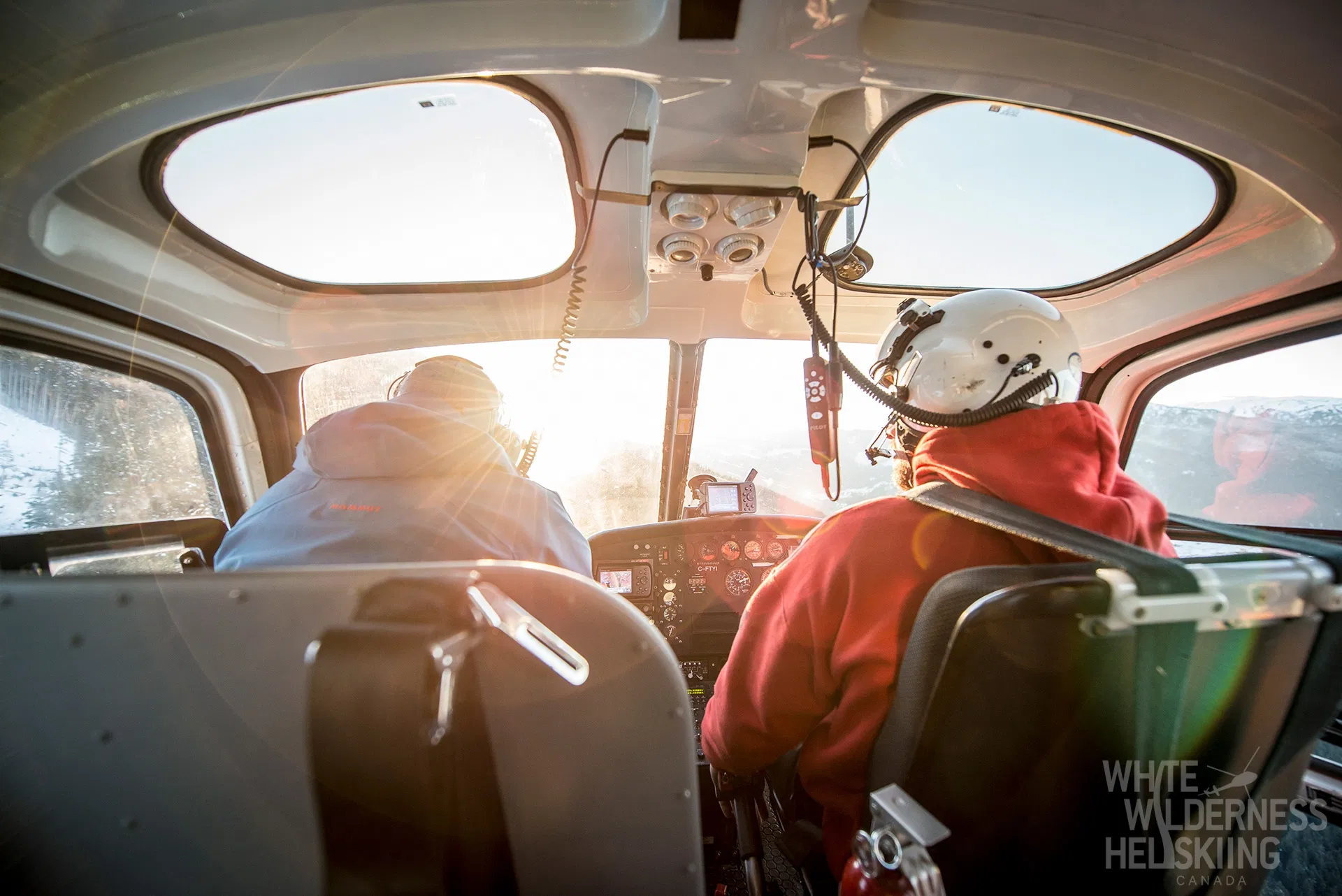
During the flight into the operating area, the pilot and guide coordinate closely. © WWH
As we climb out of Tanner’s Ferrari in a crouch and hunker down in the snow with the rotor still turning, guide Eliel unloads the skis. His thumbs-up signals to the pilot that he can take off. Trailing a plume of snow, Tanner turns the machine 180 degrees, dives like a BASE jumper and shoots down to the pickup, where he will collect the second group and catapult them back up the mountain. The moment the helicopter disappears, our eyes wander across the infinite expanse of the Skeena Mountains and settle on the Seven Sisters on the horizon, a massif with seven summits and the landmark on the far side of the Skeena River. For a few seconds, everything is quiet, almost reverently so. Then the bindings click. Avalanche-airbag handles are pulled out and backpack buckles fastened. If the tingling in our legs and the anticipation of an indescribable descent in the mild afternoon light amid a sea of peaks could make a sound, it would be deafening.
Through the Powder Like Canada Geese
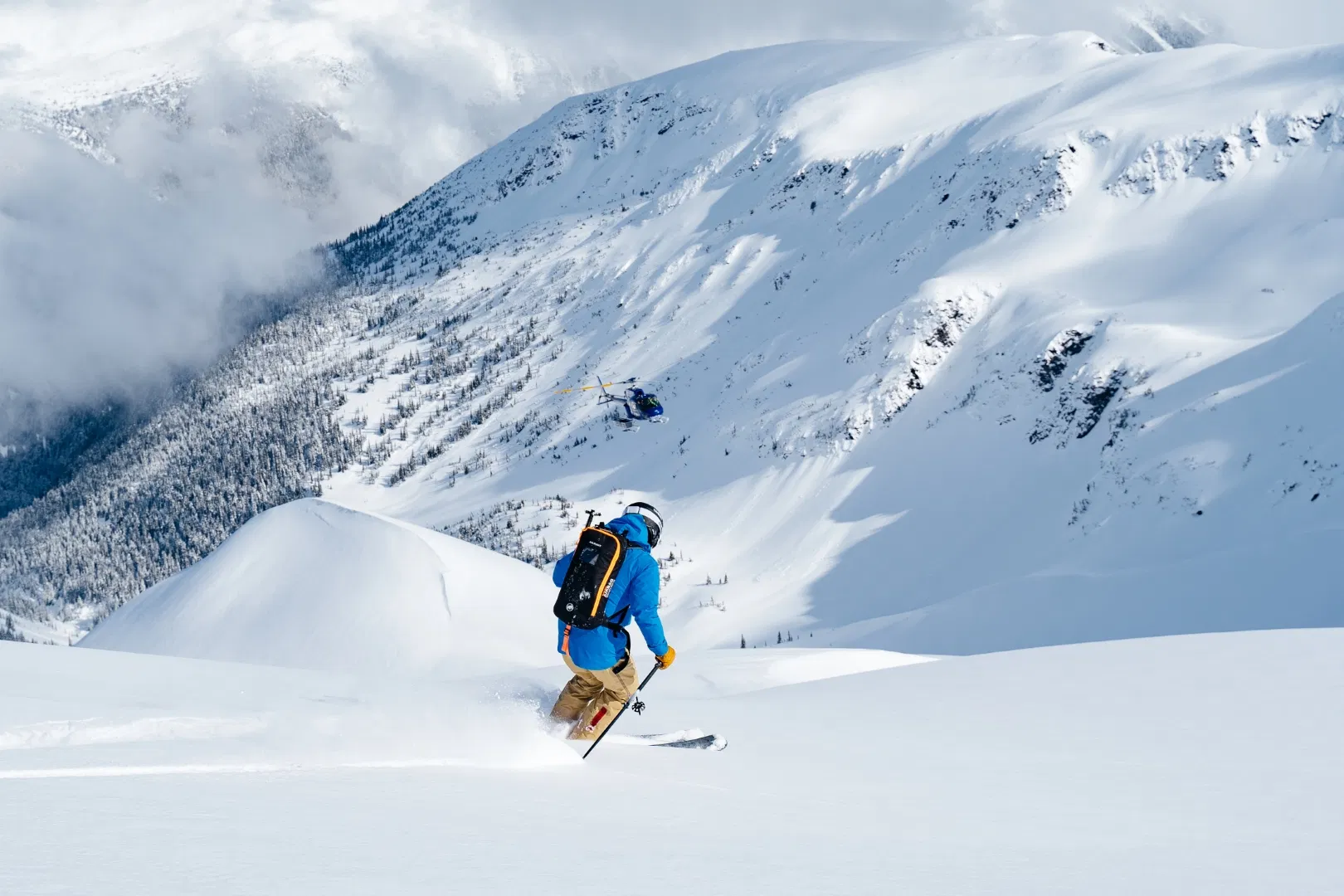
Guide Eliel leads the way. We follow in a V formation, like Canada geese, keeping a respectful distance so as not to trigger an avalanche. The light, knee-deep powder feels as sweet as running a finger through whipped cream. As we charge down the powder slope, Tanner thunders overhead at low altitude. Anyone who has experienced this spectacle once – the clatter of the helicopter, soft powder up to the ears, snow crystals whipped up by the rotors, sunshine and blue sky – is lost forever and hopelessly addicted. One guide and four tiny skiers surrounded by “The Big White”. The contrast with the pistes of the Alps, where as many as 10,000 skiers crowd around a handful of lifts on some days, could hardly be greater.
The Forest Separates the Good from the Great
Farther down in the forest, the good skiers are separated from the very good. Eliel, who grew up in eastern Canada and competed in freestyle events there, likes it steep. Even on 40-degree terrain, he always skis the fall line, takes every jump over rocky cliffs and treats the trees like slalom poles. Tree skiing is not without danger. Tree wells lurk beneath the branches: anyone who falls headfirst into one of these holes, which form around tree trunks and can be several metres deep, may suffocate in the bottomless drifted snow if help does not arrive quickly. In the forest, everyone therefore skis in pairs, stays within sight and constantly calls out “Hejo”. If someone does become lost among densely packed Canadian cedars, every guest and guide carries a radio.
© WWH
HELISKIING ENTREPRENEURS BY CHANCE
When Tanner parks his Ferrari right beside the White Wilderness Heliskiing lodge later that day, every guest steps out of the helicopter with shining eyes. The logbook records 19 runs and almost 10,000 vertical metres. No one is happier about that than Michael Brackenhofer, Guiding Manager and Lead Guide. In that role, and naturally in close coordination and constant dialogue with his guides and the helicopter pilots, he is responsible for an entire bundle of questions from which they must jointly derive their decisions: What will the weather do? How high is the avalanche risk? Where can we fly without becoming trapped if fog rolls in? How should the groups be arranged so that every guest gets the experience they want? How much fuel do the helicopters need? When must they return to the lodge to refuel?
Brackenhofer is a veteran of the heliskiing business. The same cannot yet be said of White Wilderness Heliskiing. The company is a teenager at best. That is because the lodge was used for many years only in summer, as accommodation for sport fishers. One of the two owners is a passionate fly fisherman and had therefore stayed several times at the Skeena Salmon Lodge, run by a German couple near Terrace. The Skeena River, which flows directly past the front door of the large log house, is a mecca for fly fishers in summer. When the German couple went looking for an investor, he came on board. And when they later wanted to sell for reasons of age, it seemed almost inevitable that the regular guest would take over the entire lodge – initially, however, only for summer operations.
Some of the Heaviest Snowfall in British Columbia
The turning point came when he showed the lodge to a friend. The friend was a heliskiing enthusiast and immediately recognised the lodge’s winter potential. He was certain that the vast forests and imposing mountain ranges surrounding it would guarantee fantastic terrain. Snowfall in the Skeena Mountains is also among the heaviest anywhere in British Columbia. The two friends therefore became business partners as well. As a first step, the duo secured exclusive access to an area covering 2,200 square kilometres. The newcomers launched their first season in 2015. New runs were added almost every day, and the skiing experience improved from one day to the next. Shortly before the pandemic, they had the opportunity to lease a further 1,000 square kilometres and seized it. Today, an XL winter wonderland covering 3,200 square kilometres awaits the maximum of 24 guests accommodated by the lodge. WWH offers them a perfect mix of broad, open glacier slopes and breathtaking forest descents, with plenty of options close to the lodge for poor-weather days.
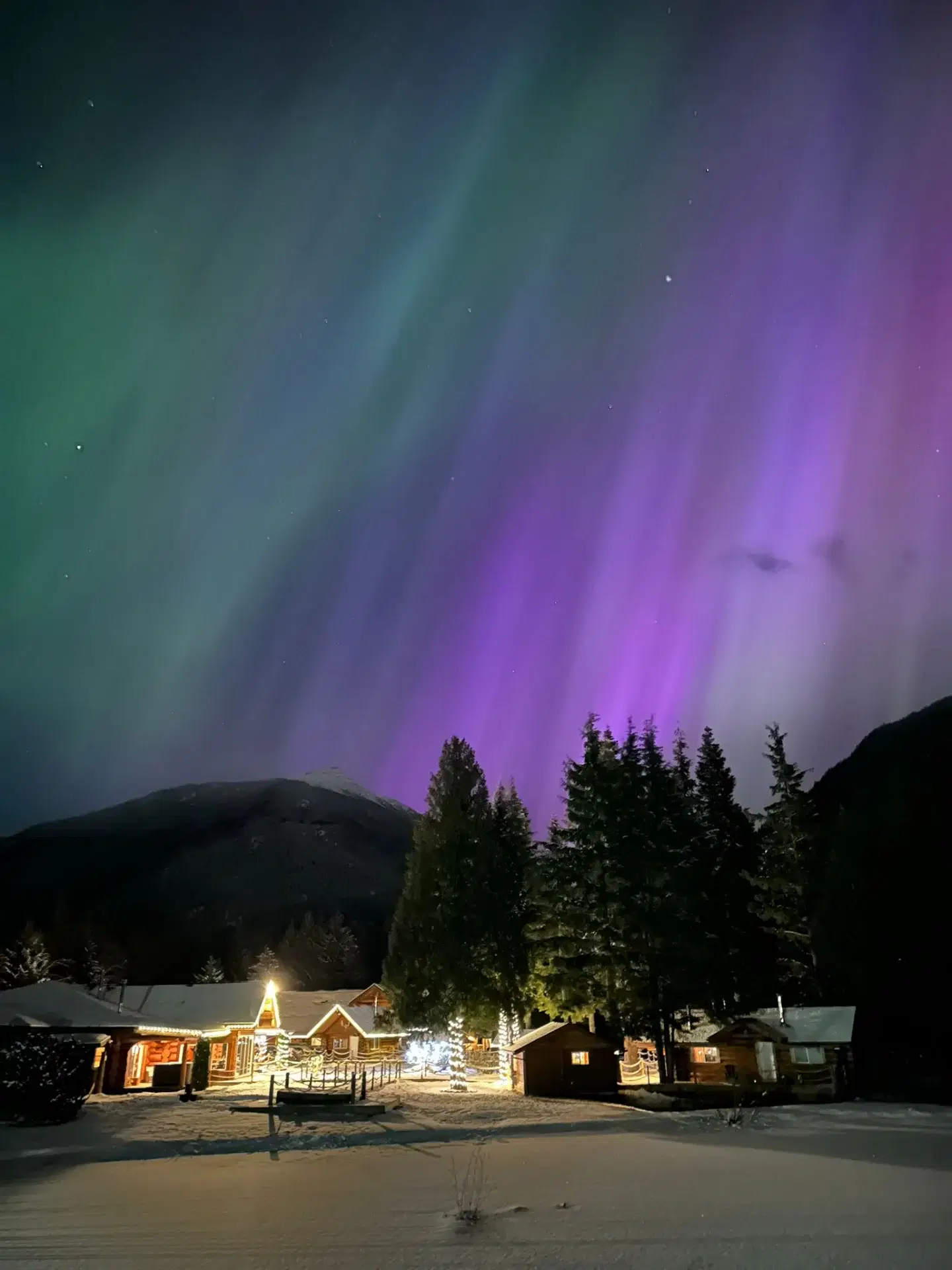
With a little luck, guests may even see the northern lights. © WWH
That, however, is only one of WWH’s trump cards. The second is its proximity to the small city of Terrace, which can be reached from Vancouver in just an hour and a half by air. From there, the lodge is less than half an hour away, while reaching competing operations can often mean losing two days to shuttle-bus transfers. Trump card number three is the lodge itself. It sits beside the river in the valley, where the ground is not always completely covered in snow, and close to the highway, which slightly tempers the wilderness feeling. In return, it boasts outstanding facilities. While other lodges often offer no more than an outdoor hot tub, WWH has a huge massage hot tub for twelve guests, a log-cabin sauna and a true wellness oasis with a steam room, bio sauna and infrared cabin in the basement beneath the superbly equipped gym. Right next door are table football, pool and table tennis for those occasions when the weather is too poor to fly. No one wants a down day, but when one does happen, there is no chance of becoming bored here.
A Superb Culinary Experience
Speaking of which, Brackenhofer and lodge manager Eve Mitchell understand that they cannot control the weather, avalanche conditions or snowpack, but they can certainly control what arrives on the plate. They therefore place great importance on sophisticated cuisine featuring as many organically grown regional products as possible. Meat comes from local farmers, and vegetables from greenhouses in the valley, including the Current Creek Farm just one kilometre away. “Our guests are accustomed to staying and dining at the highest level during their regular ski holidays in the Alps. That is what they know, and that is what they should find here as well,” Mitchell says, summing up the philosophy as her team serves freshly caught halibut from the nearby Pacific. Sushi and scallops had already been served with the aperitif, a welcome contrast to the chicken wings and nachos found at other lodges. A wine list featuring exciting selections from the New and Old Worlds completes the culinary experience.
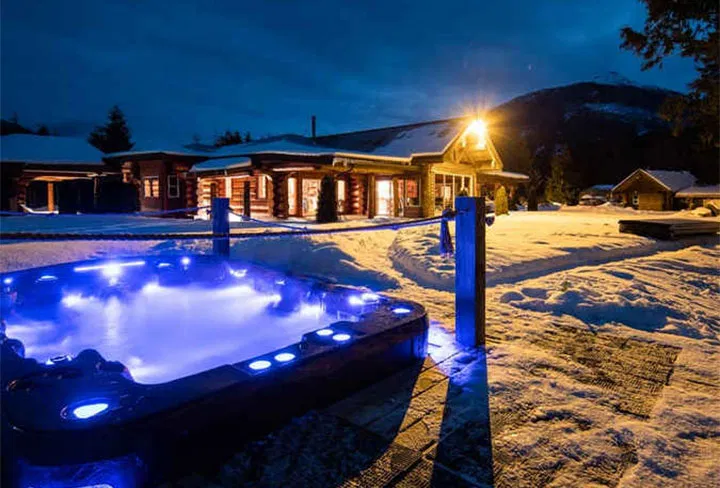
© WWH
VIP Weeks with World-Class Skiers
This commitment has propelled WWH into the ranks of British Columbia’s finest boutique heliskiing operators in just a few years. It certainly also helps that each of the two helicopters serves only three groups of four guests, keeping pickup waiting times to a minimum. Groups that are not quite as fast are often happy to catch their breath for a moment. And yes, the pace can be very quick indeed, especially during special VIP heli weeks hosted by former world-class Swiss ski racers such as Daniel Mahrer, Didier Cuche and Franco Cavegn.
Glen Plake has also visited WWH. The owners met the American freeride legend at the ISPO sporting-goods trade show. They had travelled to Munich to initiate partnerships with ski companies, but many big brands ignored the newcomers. Almost by chance, they ended up at the Elan stand and met Plake, one of the Slovenian company’s brand ambassadors. Elan’s managers were also interested in the new heliskiing lodge, and a skiing partnership was born that continues to this day. Plake has, of course, also visited the Skeena Mountains himself. Somehow, despite his trademark mohawk, he even managed to fit inside the flying Ferrari. “I love skiing here,” the punk rocker of the scene enthused afterwards. Head and Burton have since joined as two further sponsors, allowing guests to test the latest freeride models from Elan and Head as well as Burton snowboards free of charge.
The Best Powder on the Planet
The next morning, low clouds hang above the Skeena River valley. While most guests are still asleep and a few keen participants attend the stretching class, the heli guides gather for their conditions briefing. Anyone who has ever listened in quickly realises how absurd it is to tell these men, and the few women among them, that playing in the best powder on the planet every day cannot possibly be hard work. They shoulder enormous responsibility, because safety always comes first at WWH. Defining the day’s strategy is a complex task.
The Most Beautiful Job in the World
During breakfast, Eliel gives us the go-ahead: the clouds have almost completely cleared, and we can fly! Tanner removes the night cover from his Ferrari, and moments later the rotors begin to clatter. Runs with names such as “Most Magnificent” and “Ski World” promise an epic day. Then we are already dropping into the first untouched powder slope. Today we are skiing with Michaela, the only woman on the guide team. When we unclip our skis at the bottom and wait for the pickup, she tells our group of four with a broad grin: “I love heliskiing!”
Perhaps she is right. Perhaps the guides really do have the most beautiful job in the world.
Text: Günter Kast; photos: WWH/Nicole Kunas
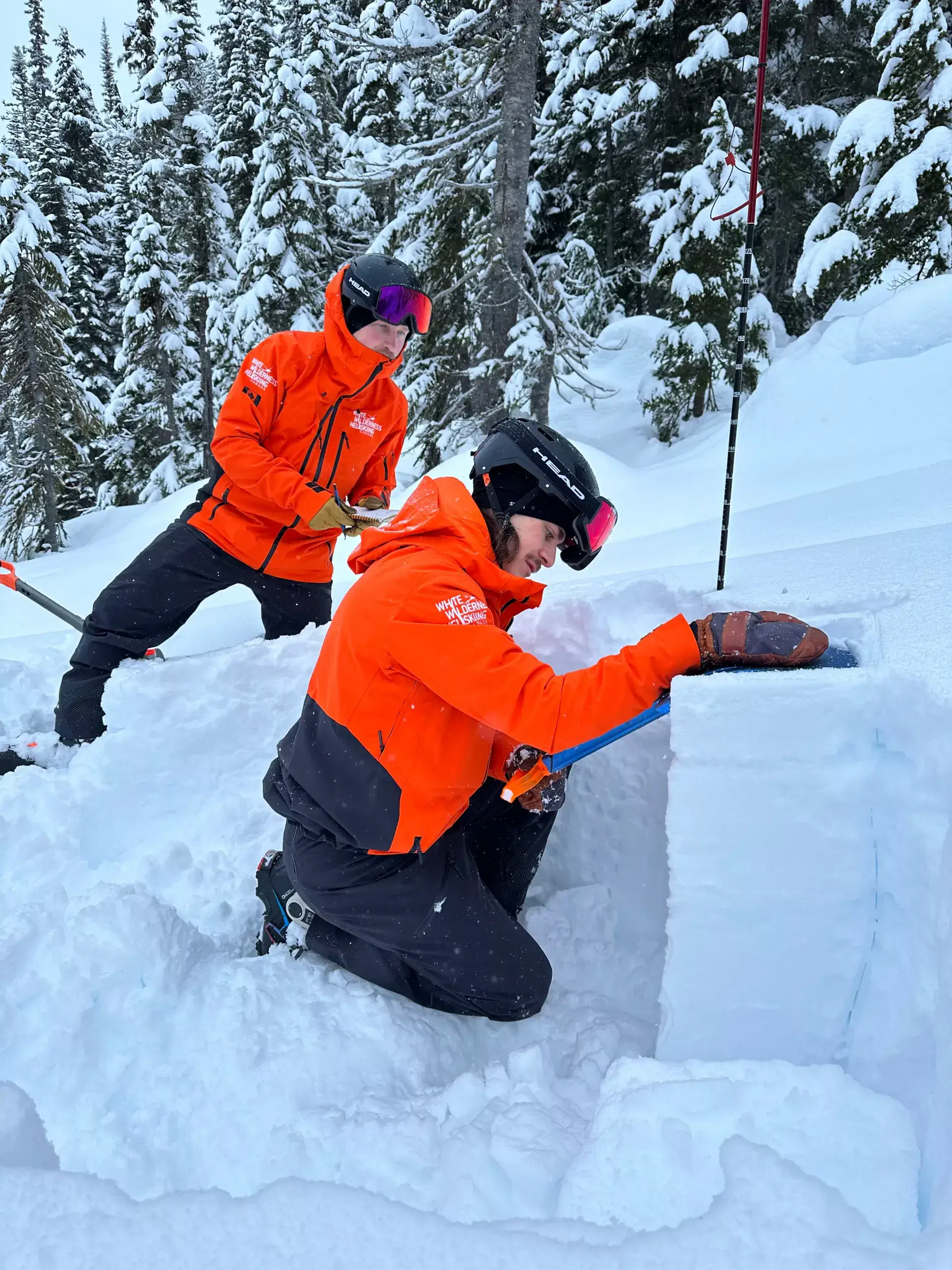
The guides use a Rutschblock test to assess the stability of the snowpack – because safety always has the highest priority. © WWH
Getting to White Wilderness Heliskiing
General Information
Travel
With Air Canada (www.aircanada.com) – ski equipment travels free of charge – direct from Zurich, Munich or Frankfurt to Vancouver and onward to Terrace the same day, allowing guests to enjoy their first dinner together at the lodge on the day of departure. Travellers arriving with other airlines are best advised to spend the night at The Fairmont Vancouver Airport (www.fairmont.com/vancouver-airport-richmond). Its soundproof rooms feature floor-to-ceiling windows looking directly onto the airfield. The following day, the journey continues with Air Canada to Terrace, around 800 kilometres north of Vancouver and 60 kilometres from the Pacific, followed by the short transfer to the lodge.
Entry Requirements
A passport valid for at least another six months and an eTA registration are required: www.cic.gc.ca/english/visit/eta.asp
Tour Operator
White Wilderness Heliskiing: www.wwheliski.com. Advice and bookings in Germany are available from the heliskiing specialists at Aeroski Reisen Dr. Erben GmbH: www.aeroski.com
Vancouver
Visitors should definitely allow several days for British Columbia’s largest city (www.destinationvancouver.com). The Vancouver Destination Experience Pass is an excellent choice and offers numerous discounts. Anh and Chi (https://anhandchi.com) serves authentic Vietnamese cuisine at moderate prices and has earned a Bib Gourmand. Those seeking fine dining should reserve a table at the Hawksworth Restaurant (www.hawksworthrestaurant.com) in the venerable Hotel Georgia, part of the Rosewood group, in the city centre. As already mentioned, The Fairmont Vancouver Airport is a convenient place to stay and can also store ski luggage.
To learn more about the culture and history of the First Nations, book the Spoken Treasure tour with Talaysay Tours (www.talaysay.com). It begins in Stanley Park, once home to Indigenous communities. Highly recommended!
Source: SKIMAGAZIN, Günter Kast, “Welcome to the White Wilderness”, January 16, 2026.